The Role of Autonomous Agents in the Future of Work
The workforce landscape is undergoing a radical shift. Roles are charging. Hiring to scale is moving beyond traditional outsourcing toward a model of workforce transformation. As of April 2026, the industry is abandoning the "pyramid model" of mass junior staffing in favor of a leaner, diamond-shaped structure powered by AI agents. This isn't just a trend; it's an "adapt or exit" ultimatum for the modern professional.
by Frank Wang, CTO (Co-Founder) + Kevin Riley, CEO (Co-Founder)
There are millions of open jobs in healthcare - and Agents will fill them. This is a bold statement for sure. How do we know that this is the new way of working?
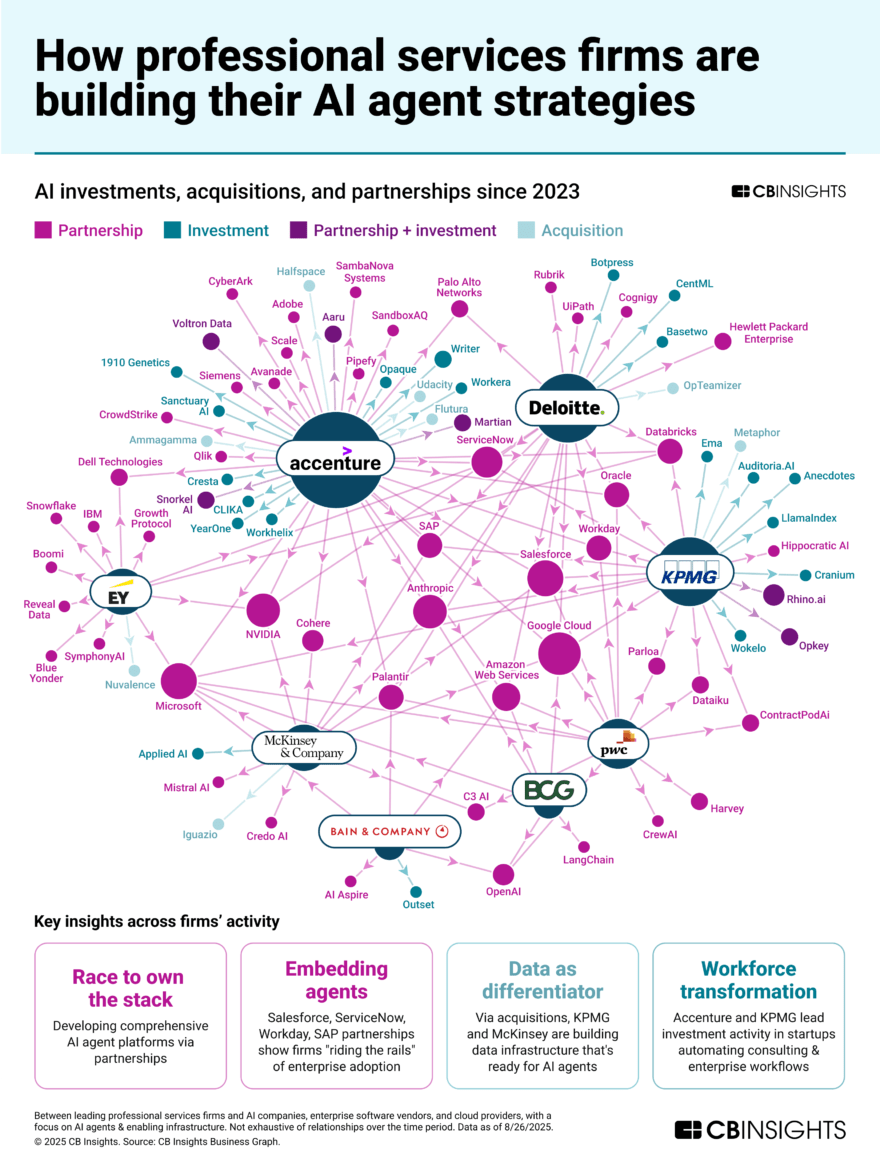
We have to go no further to look where the major consulting firms are investing - and divesting, for that matter. This image from CBInsights says it well. It is ALL about their work to partner and use the new tools that will create what amounts to BPO 2.0. They are betting on going from outsourcing to “workforce transformation”.
From the Market’s Point of View
As of April 2026, the industry is moving away from the traditional "pyramid model"—where a massive base of junior staff supports a few partners—toward a leaner, "diamond-shaped" structure powered by AI agents.
1. The "Adapt or Exit" Ultimatum.
Firms are no longer just encouraging AI use; they are making it a condition of employment. PWC took a hardline stance in March 2026, when its US CEO, Paul Griggs, issued a direct warning: partners and staff who fail to embrace AI have "no future" at the firm. He explicitly stated that employees who think they can "opt out" of AI are not going to be here that long." McKinsey has integrated its proprietary AI, Lilli, into its performance reviews and recruitment processes. Candidates for entry-level roles must now pass an "AI proficiency assessment" using Lilli. Current consultants who cannot demonstrate the ability to "supervise" AI agents—rather than just doing the manual work themselves—are being phased out through tightened "up-or-out" performance metrics.
2. Layoffs Driven by "Low Attrition" and AI
Consulting firms traditionally rely on a 15–20% annual "churn" (people leaving for other jobs). Because fewer people are leaving voluntarily in the current economy, firms are using AI-driven restructuring to force exits. KPMG recently moved to cut hundreds of roles in the UK (approx. 600 jobs), specifically targeting "Assistant Manager" roles in audit and advisory. McKinsey cited a combination of low attrition and "structural pressure" from AI, reducing the manual effort required for these mid-to-junior tasks. At PwC and Deloitte, both firms have conducted significant layoffs over the past 12 months (PwC cut ~5,600 roles globally) as they transition to "outcome-based pricing" rather than billing by the hour. When you bill for results rather than hours, the incentive to keep large teams of junior "billable" staff disappears.
3. Jobs Being Replaced by AI Agents
Firms are replacing specific high-volume, low-complexity tasks with autonomous agents. As the image shows, they are building, buying, and allying with companies like mine to offer managed services for their new model of defining, hiring, and managing digital, agentic workforces.
4. The Shift to "AI Agent Supervisors."
The "new" consulting job isn't about doing the work; it's about managing the AI that does it. Entry-level consultant hiring has dropped by roughly 40% from its 2023 peak. Conversely, hiring for "AI Architects" and "Agent Supervisors" is up. And - despite a major security breach of McKinsey’s Lilli platform in early 2026 (exposing millions of internal messages), the firm has doubled down on the tool, stating it saves roughly 50,000 consultant hours per month. This efficiency gain effectively replaces the workload of hundreds of full-time employees.
From Our Point of View
“As the CTO and Co-Founder at actAVA, I have a real point of view on this subject”, says Frank Wang, CTO.
By way of example, at actAVA, our development experience has completely flipped. Coding agents now compress work that used to take a full engineering team a week to complete. One person finishes it in an afternoon. Each of our engineers runs multiple agents in parallel. They plan the feature, write the code, run the tests, and close the loop end-to-end. A single engineer driving agents now does the work of five to ten engineers from two years ago.
Communication is the bottleneck now. We're shipping so fast that keeping the team in sync is the real work. What's live, who's building what, how a new feature moves through product, support, customer success, deploy engineering, and lands with the customer. That's where the friction lives now. It's why we run two standups a day at actAVA, morning and afternoon. We have to resync twice just to know what's out the door.
The old performance metrics are broken. Most companies still treat AI as a 50-80% productivity bump. So they hand an engineer a task, wait roughly the same amount of time, and expect a normal-sized result. In reality, that engineer can ship multiples more. The management model hasn't caught up.
Some companies are now grading engineers by commit volume and token burn, which is how much AI inference a person consumes. The pattern they're watching is simple: the layer with fewer commits and lower token burn tends to be the one lagging in adoption. It's a blunt signal. But it might be tracking something real.
Says Frank Wang, “Let me give you a number. A feature that would have taken me a week took two hours. End-to-end. Roughly 200 million tokens on Claude Opus 4.6. About $70 with prompt caching. Roughly ten times that without it. Call it a couple of hundred dollars for one productive engineering day.”
This figure changes how you think about the IT budget. AI agents deserve their own line item. Separate from SaaS. Separate from headcount. They do human work, and they multiply what humans can do on top of it.
“And healthcare will be no different”, says Kevin Riley, CEO.
“AI is predicted to cause the loss of hundreds of thousands of healthcare jobs, though few of these losses are expected to occur among physicians, nurses, and allied health professionals (AHPs) within the next decade.” Data entry operators (85%), filing/records clerks (80%), and billing/coding roles face the highest risks.
This shift requires human capabilities to ascend the value chain. As one expert noted, "Tasks that are repetitive, rules-based, or data-heavy are the most vulnerable." Furthermore, taking a passive stance on AI is no longer viable; it's a direct path to becoming obsolete. A recent Microsoft study illustrates this impact, identifying customer service representatives and telephone operators as being among the top 10 occupations most at risk from AI. Conversely, the study found that phlebotomists and nursing assistants were the two least threatened professions.
However, the news is not all bad. Despite AI replacing tasks, healthcare roles (nurses, therapists, aides) are projected to grow as AI augments rather than replaces them. AI voice-to-text is expected to result in work time savings of 17% for doctors and 51% for registered nurses, rather than 100% replacement.
If you are not watching your agents’ daily productivity, you are missing something. If you are not looking weekly at your agent build and run patterns, you're missing something. Every serious company will soon spend real money on AI inference. The ones who treat it as a cost center will miss the story. This is the most productive spend on the balance sheet.