HR Isn't a Cost Center. It's the Engine of Your Business.
Healthcare and Life Sciences companies are no different from any other companies. They are made up of the people who run them, do the work, and support their customers. For too long, People Operations at HLS companies has been treated as a reactive, administrative, and underpowered support function. In an era of AI, that calculus has fundamentally changed.
In most industries, human resources is treated as a back-office function — a compliance checkbox, a recruiting inbox, a policy library. But in healthcare, that framing is catastrophically expensive. Every unfilled nurse position, every exit interview that reveals preventable attrition, every orientation week spent onboarding someone who will be gone in eighteen months — these are not HR problems. They are financial hemorrhages with names, job titles, and salaries attached to them.
People Operations — done well — is a revenue-protective function. Done poorly, or left to spreadsheets and gut instinct, it quietly destroys margins. The 2026 data makes this impossible to ignore.
By the numbers
The 1% rule: Each 1% change in nurse turnover costs or saves the average hospital approximately $295,000 annually. That is not a rounding error — that is a budget line that People Operations either controls or doesn't.
Where the money goes
Turnover cost is not a single line item. It cascades across four distinct categories, each with its own compounding drag on hospital margins.
The specialties most exposed to this drain are also the most clinically critical:
Several of these units see turnover exceeding 100% over a five-year window. That means the average hospital replaces every nurse on the floor every five years — or faster.
Hidden costs no spreadsheet captures
Beyond the calculable financial damage, chronic turnover degrades the very things that make healthcare work: patient safety and staff wellbeing.
From administrative function to strategic lever
Most healthcare HR teams are not failing because their people lack skill or commitment. They are failing because the volume of work — recruiting, onboarding, scheduling, retention analysis, compliance, performance tracking — was never designed to be managed by human teams at the scale modern healthcare demands.
The average hospital HR department manages thousands of employees, dozens of open roles at any time, multiple collective bargaining agreements, regulatory compliance across state and federal frameworks, and a workforce that is increasingly mobile and increasingly burned out. The math has never worked. Tools like applicant tracking systems and HRIS platforms helped at the margins. But they didn't change the underlying equation.
AI agents do.
actAVA KORA — purpose-built for people ops
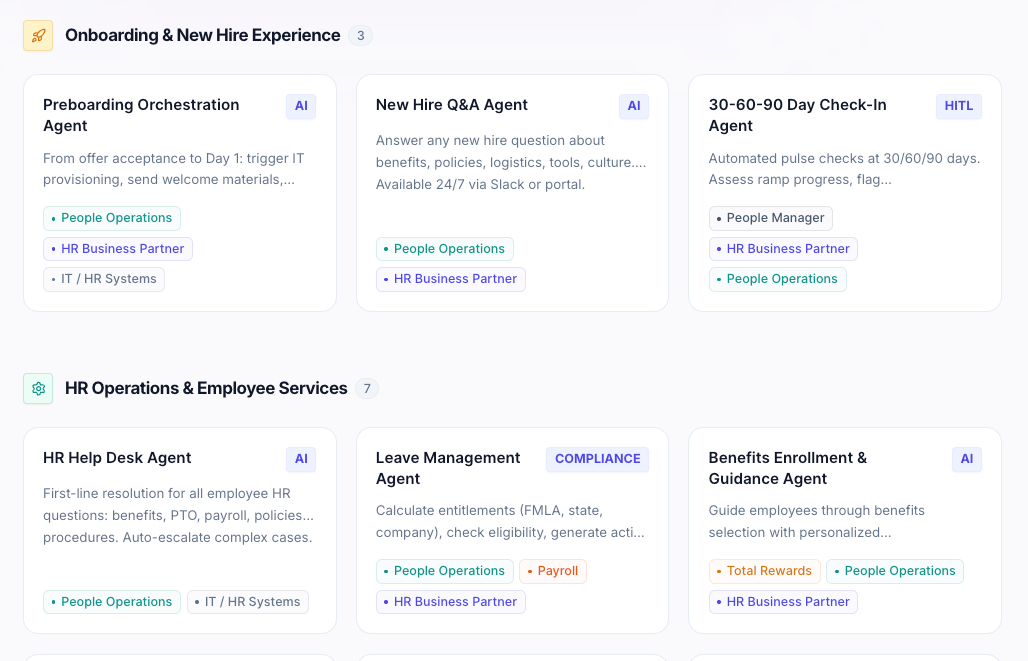
The agents actAVA has built for HR
actAVA's KORA platform delivers a suite of AI agents purpose-built for the complexity of healthcare HR and People Operations. These are not chatbots bolted onto an existing HRIS. They are autonomous agents that take action, surface insight, and remove friction across the full employee lifecycle — governed, tested, and continuously improving.
The bottom line
HR is a financial function. Treat it like one.
The $4.2M–$6.2M annual loss the average hospital absorbs from nursing turnover alone is not inevitable. It is a product of systems that were never built to handle the complexity and volume of modern healthcare people operations.
AI agents don't replace HR teams. They give those teams leverage — the ability to operate at a scale and speed that manual workflows cannot match. The hospitals that deploy this leverage will spend less per hire, lose fewer nurses in year one, carry lower travel nursing costs, and deliver better patient outcomes as a byproduct of a more stable workforce.
That is what well-executed People Operations looks like in 2026. Not a back-office function — a margin-protecting, quality-driving strategic capability. One that, through actAVA's KORA platform, runs on governed, tested, and continuously learning AI. Built, tested, learned, guided.
Data sourced from the 2026 NSI National Health Care Retention & RN Staffing Report and related industry analysis. Individual hospital results will vary based on size, region, specialty mix, and existing retention programs. actAVA KORA platform capabilities are subject to the implementation scope.