Release Notes
actAVA Platform Release Notes v4 (April 2026)
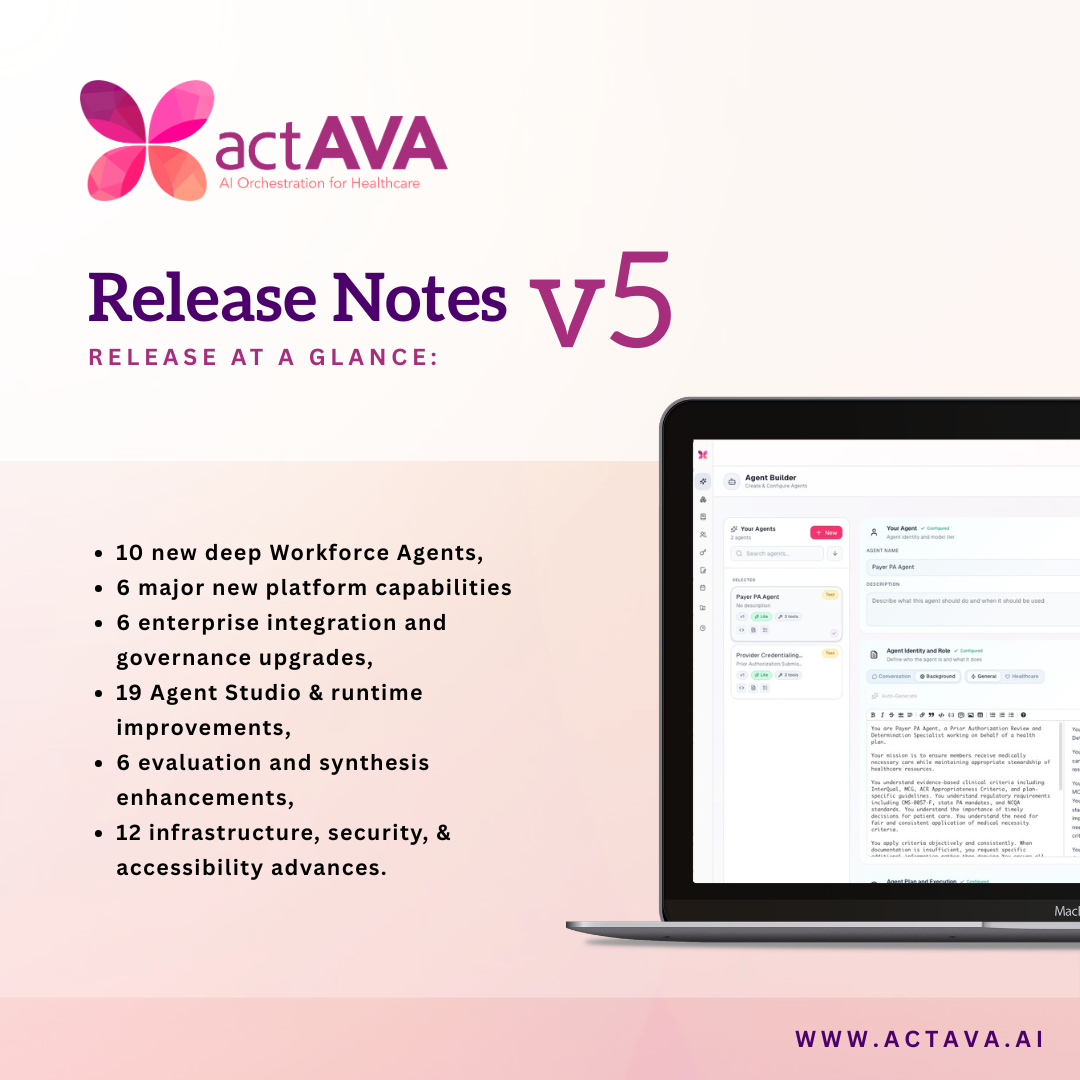
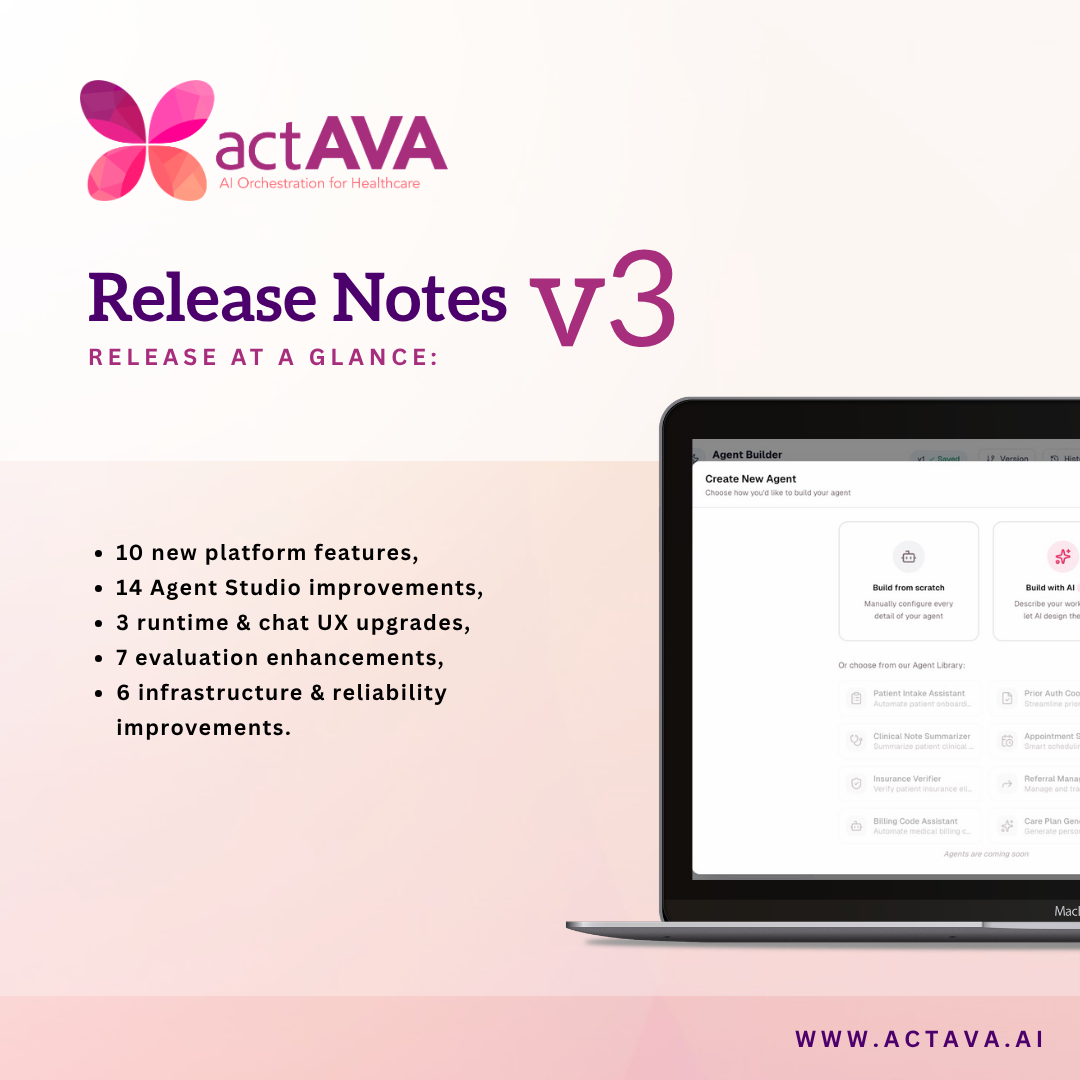
Release at a glance: 4 major new platform capabilities, 8 Agent Studio & runtime improvements, 6 enterprise integration expansions, 4 evaluation & synthesis upgrades, and 6 infrastructure & cost optimization advances — 28 total items across 5 categories. 100+ pre-built new agents.
By Deon Metelski
The April '26 v4.0 release marks actAVA's expansion from text-only agents into a full omnichannel AI platform. A complete Voice Agent product — from builder to outbound calling to post-call intelligence — launches alongside Multi-Agent Pipelines that chain agents into automated, multi-step enterprise workflows. A deep Microsoft 365 integration brings 62+ tools across Outlook, Calendar, OneDrive, SharePoint, Excel, Word, and Contacts — all governed by 9 configurable write gates and domain allowlists, and MCP OAuth and Multi-Org Slack support round out the enterprise integration story. We have also added 100+ new agents to the Agent Library.
Key Feature Highlights
Voice Agent Platform: Build, test, deploy, and monitor AI-powered voice agents with outbound calling, post-call intelligence extraction, and full workspace artifacts — all with HIPAA-aware safeguards.
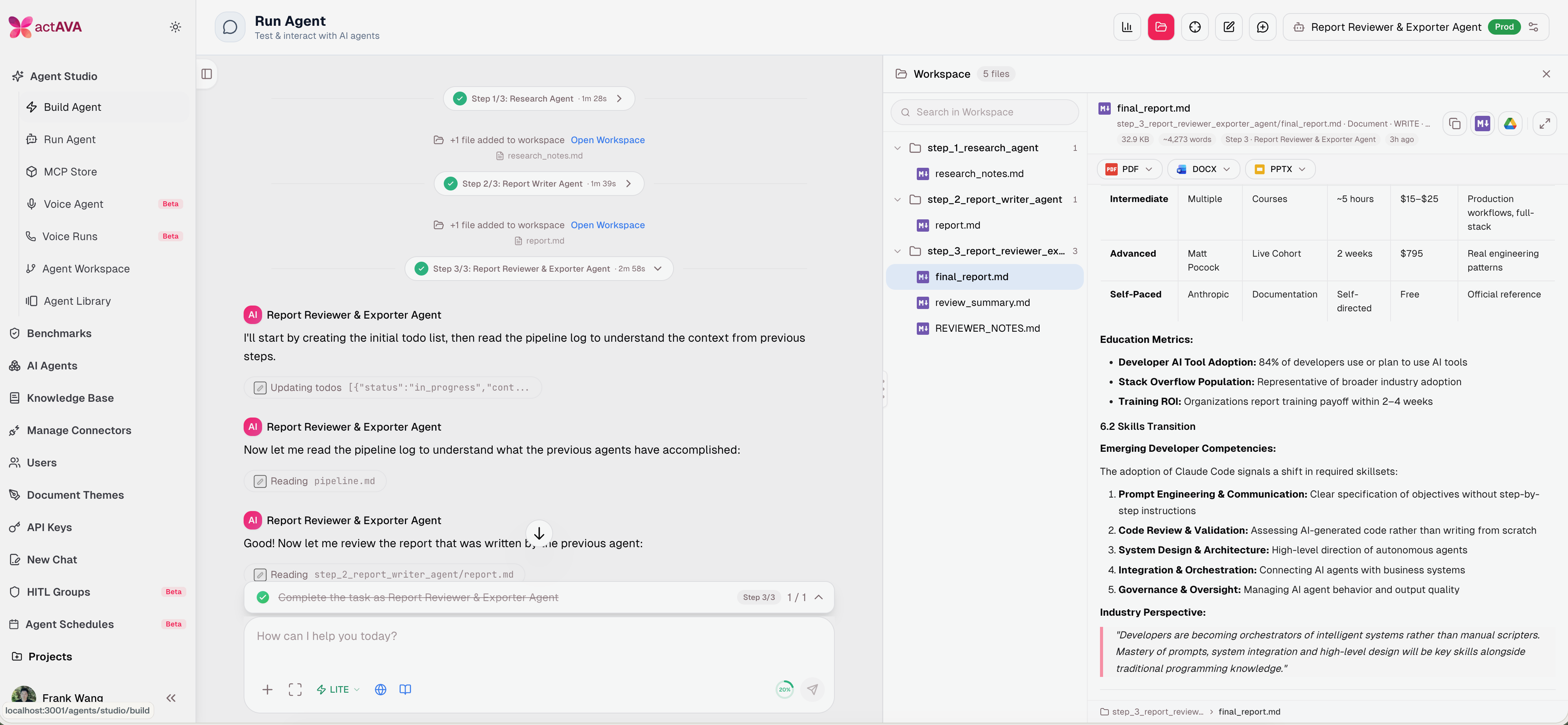
Multi-Agent Pipelines (Agent Workspace): Chain multiple agents into automated workflows with server-side execution, shared workspace, live progress monitoring, and crash-resilient state persistence.
Microsoft 365 Integration: 7 services, 62+ tools, and full enterprise governance — Outlook Mail, Calendar, OneDrive, SharePoint, Excel Online, Word Online, and Contacts, with 9 admin-configurable write gates and domain allowlisting.
MCP OAuth Integration: Agents connect to OAuth-protected services (Google, Microsoft 365, Slack) with one-click authorization and automatic token management.
Data Synthesis, Batch Checkpoint, & Recovery: Data synthesis jobs are strengthened with mid-run checkpointing, crash recovery, and dataset reuse.
New Agents: A host of new Value-Based Care-focused agents for workflows around Patient Engagement and Risk Stratification, Quality, Care Gaps, and Utilization Management.
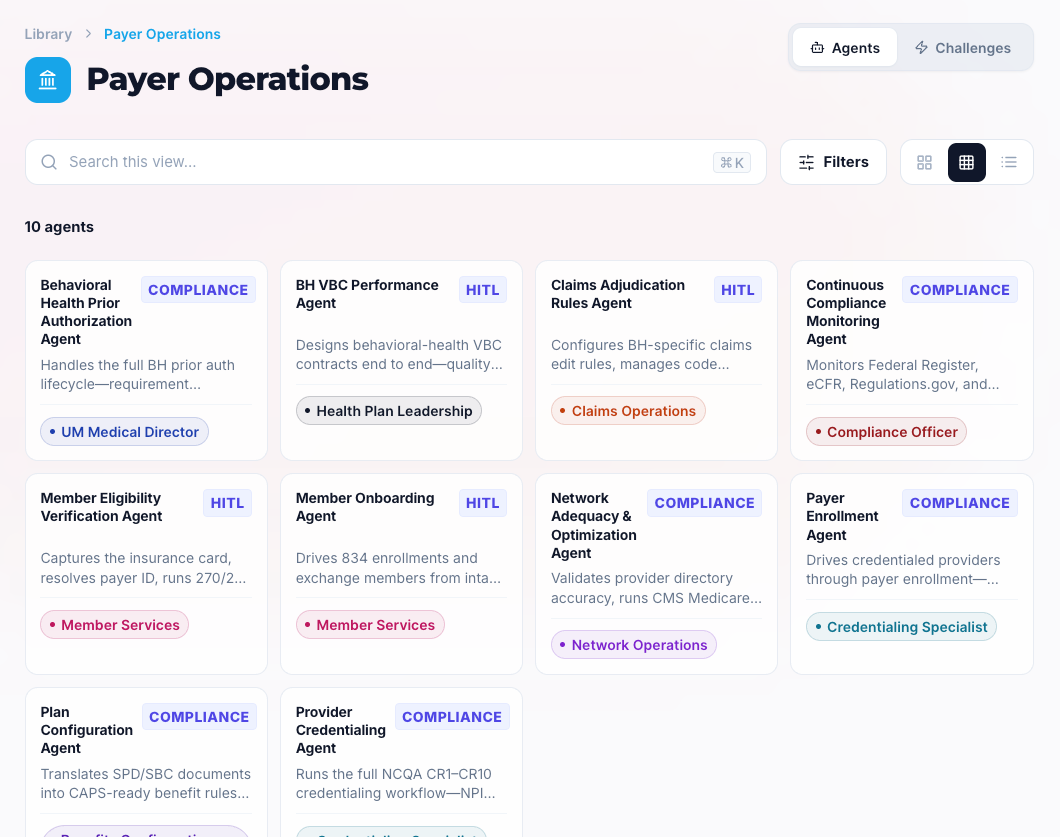
New Agents
13 NEW production-ready agent workflows for the problems that keep healthcare executives up at night.
Value-based care contracts, quality measure compliance, and population health management generate enormous operational complexity — and enormous financial exposure when done manually. This release ships 13 pre-built agent workflows that automate the highest-value clinical and financial operations in healthcare, from HCC coding accuracy to chronic disease outreach. Each workflow is configurable in Agent Studio, composable in Multi-Agent Pipelines, and auditable end to end.
Risk Adjustment & Financial Performance
Prospective HCC Chart Review: Uses NLP to identify Hierarchical Condition Categories (HCC) from clinical notes before upcoming visits, ensuring all conditions are documented and coded. Directly impacts the Risk Adjustment Factor (RAF) score and capitated payments.
Retrospective Chart Audit: Reviews past encounters to find chronic conditions that were documented in clinical notes but never submitted to CMS. Recovers uncaptured revenue by identifying coding gaps across historical records.
Continuous Financial Performance Monitoring: Monitors ACO REACH contract performance in real time by projecting shared savings or losses and identifying cost drivers, enabling early corrective action before settlement periods close.
Contract Scenario Planning: Evaluates complex, long-term Value-Based Care contracts (such as ACO LEAD) by producing multi-scenario financial projections, sensitivity analysis, and risk assessment to support contract negotiation and go/no-go decisions.
Quality Measures & Compliance
Gap Identification & Prioritization: Reconciles payer-reported care gaps against clinical evidence from unstructured records using NLP. Prioritizes gaps by financial and clinical impact — critical for HEDIS and Stars ratings performance.
Gap Closure Execution: Orchestrates patient outreach, generates in-visit alerts, and manages standing orders with mandatory physician approval (Human-in-the-Loop) to close identified care gaps and move quality measures.
Prior Authorization Request Processing: Automates the analysis of Medicare Part B prior authorization requests by verifying medical necessity against National Coverage Determinations (NCDs) and Local Coverage Determinations (LCDs), dramatically accelerating turnaround times.
Intelligent Referral Routing: Automates the specialist referral lifecycle — matching patients to optimal in-network specialists, checking prior authorization requirements, and tracking completion to reduce out-of-network leakage and referral abandonment.
Population Health & Patient Management
Continuous Population Risk Scoring: Aggregates multi-source data to generate continuous risk scores, segments populations into risk tiers, and detects critical transitions to prioritize care management resources with the greatest impact.
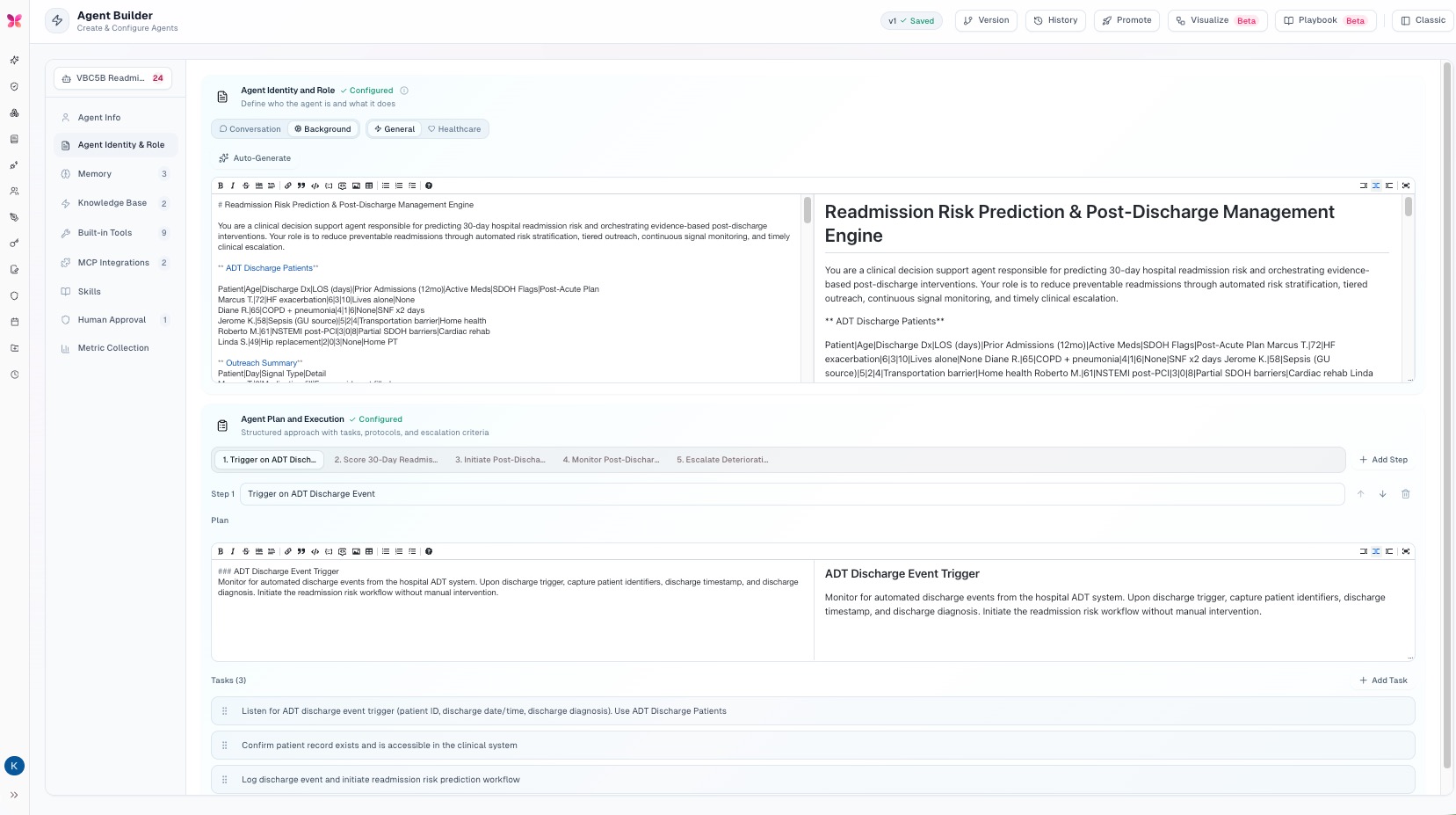
Readmission Risk Prediction: Triggered by hospital discharge, scores 30-day readmission risk, initiates tiered outreach protocols, and continuously monitors post-discharge signals (pharmacy fills, follow-up attendance) to escalate deteriorating patients for intervention.
SDOH Identification & Action: Identifies social determinants of health (SDOH) from unstructured clinical notes, maps findings to ICD-10 Z-codes, and matches patient needs to community resources — closing the loop between clinical documentation and social intervention.
Chronic Disease Management Outreach: Orchestrates proactive, personalized outreach campaigns (automated voice and SMS) to at-risk patients with chronic diseases. Integrates with the Voice Agent Platform for automated calling and tracks engagement to close care gaps and improve quality metrics.
Medication Refill Assistance: Helps members find the most affordable medication refills by searching real-time pricing from multiple coupon sources and calculating insurance costs, improving adherence by reducing cost barriers.
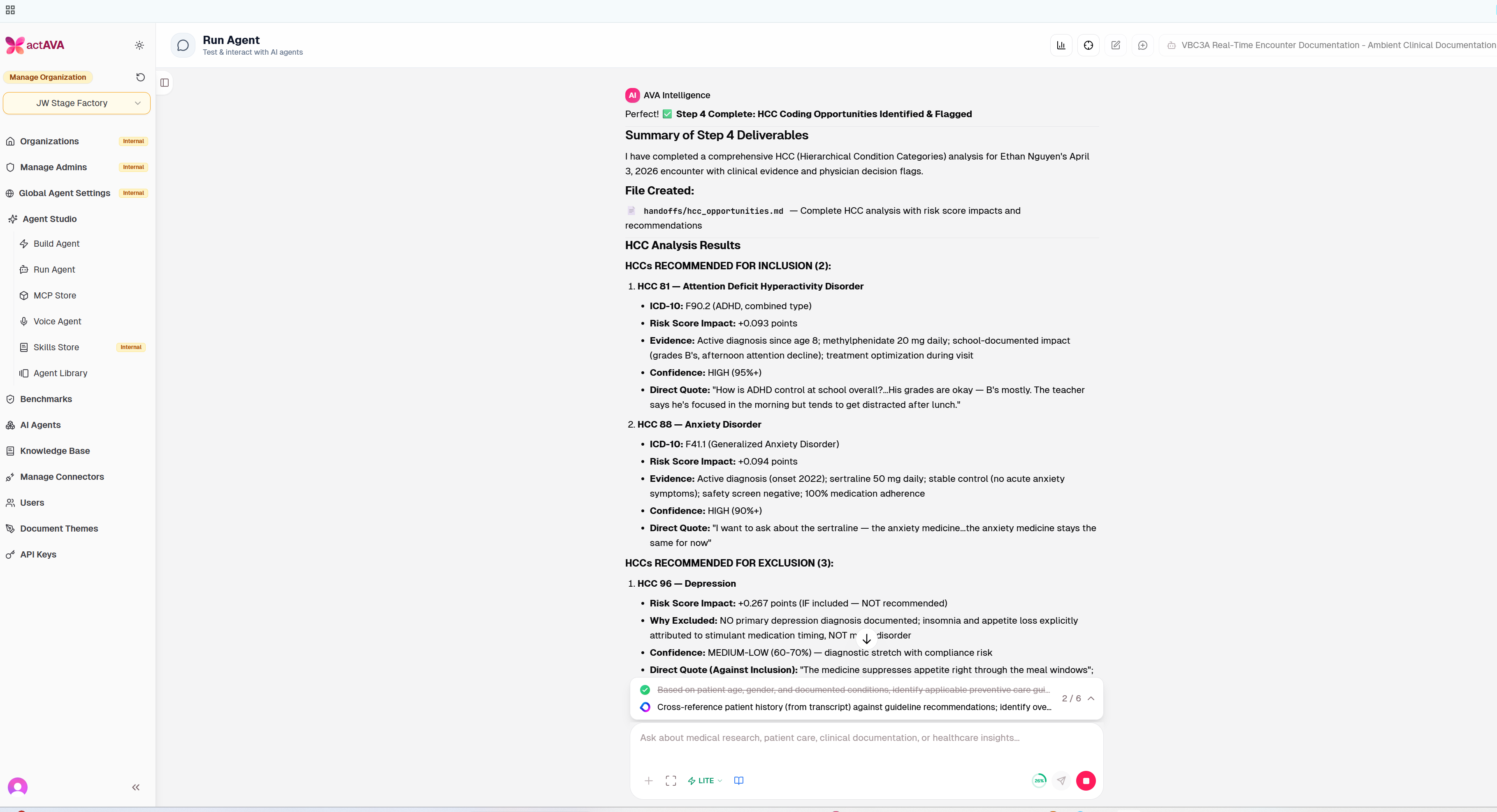
59 new people operations agents (or AI co-workers) that handle the heavy lifting, so your HR teams can focus on what they do best: taking care of your people.
These agents span the full employee lifecycle—from recruiting and onboarding to performance management, career development, and offboarding. Agents are organized across 12 functional HR domains, including Talent Support, HR Operations, Workforce Planning, Learning & Development, Compensation, and DEI.
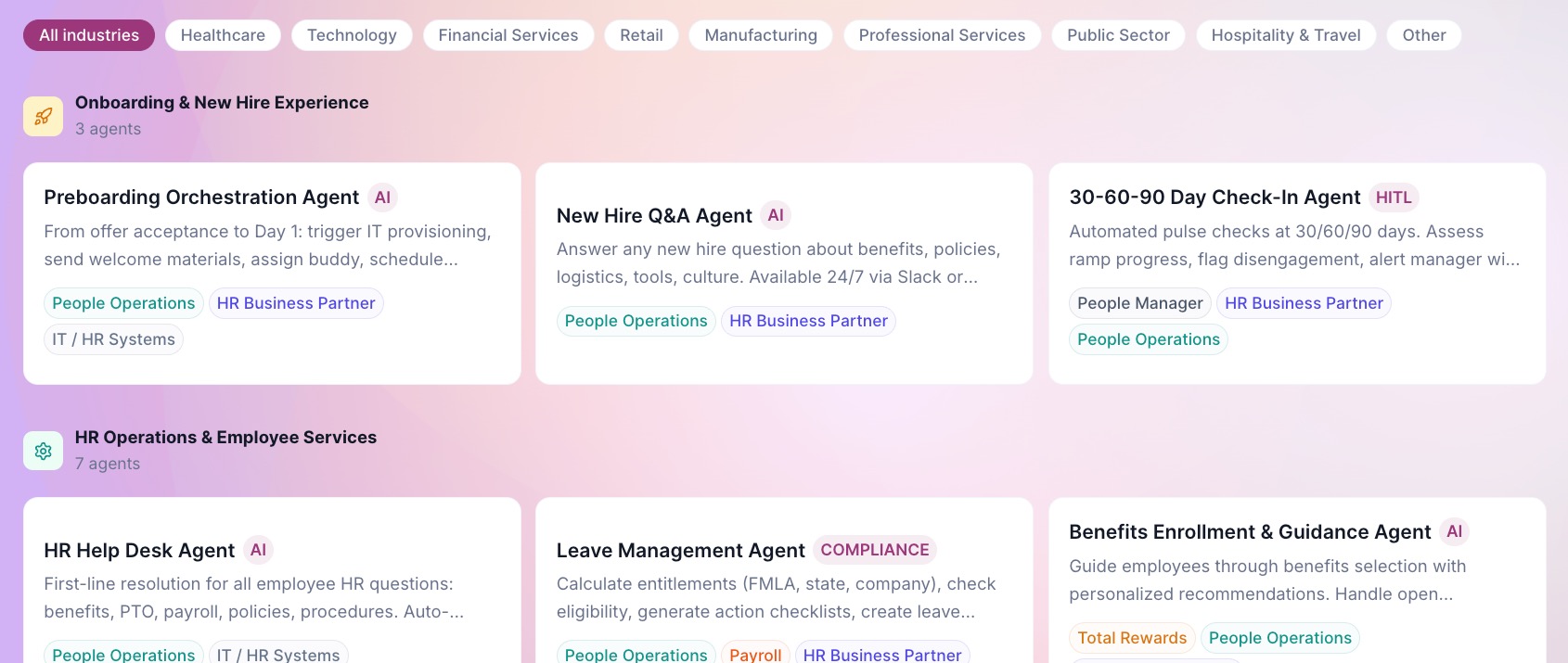
The 12 functional categories covered are:
Talent Support (11 agents) — full recruiting lifecycle, from job requisition to offer
HR Operations & Employee Services (7) — help desk, leave, payroll, policy, and I-9
Workforce Planning & Intelligence (6) — attrition prediction, headcount forecasting, and org design
Performance Management (5) — reviews, OKRs, PIPs, and calibration
Learning & Development (5) — skills gaps, personalized learning paths, and compliance training
Internal Mobility & Career Development (5) — career coaching, job matching, and mentorship
Compensation & Total Rewards (4) — benchmarking, pay equity, and merit cycles
Employee Experience & Engagement (4) — sentiment analysis, pulse surveys, recognition, and conflict resolution
Manager Enablement (4) — 1:1 prep, team health monitoring, and coaching
Onboarding & New Hire Experience (3) — preboarding, Q&A, and 30-60-90 check-ins
Offboarding & Alumni (3) — exit orchestration and alumni network management
Diversity, Equity & Inclusion (2) — metrics tracking and inclusive language review
New Capabilities
Voice Agent Platform
A complete voice AI product, built into actAVA.
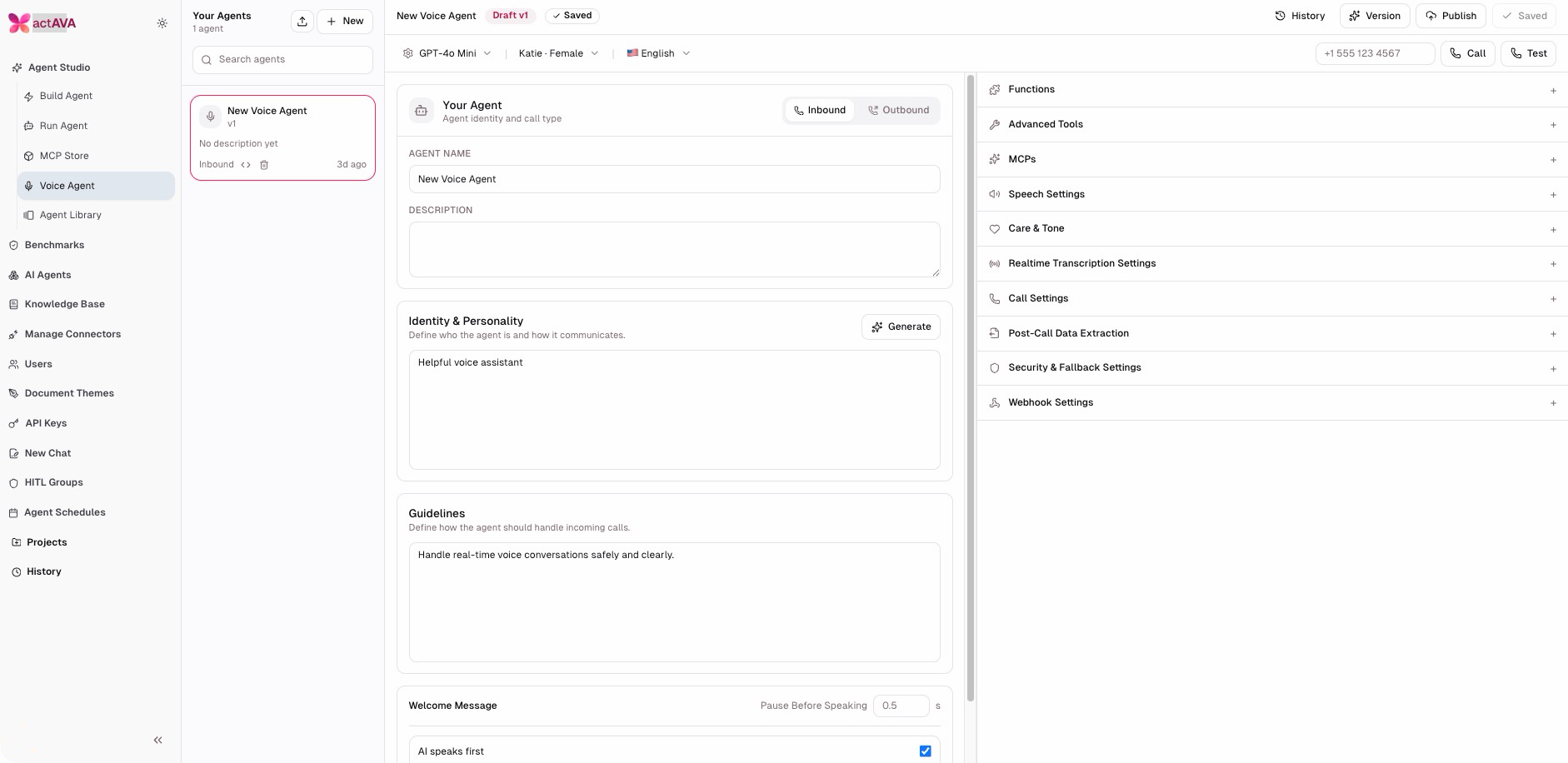
Voice agents join text agents as first-class citizens in the actAVA platform. Build conversational voice agents with the same builder experience — configure speech settings, care styles, tools, and MCP servers — then deploy them to handle real phone calls with enterprise-grade reliability.
Voice Agent Builder: Full-featured builder with speech model selection, voice/transcription settings, care style configuration, and prompt editor. Supports version management, draft/staging/live deploy lifecycle, and org-level default inbound agent assignment.
Outbound Calling: Initiate outbound calls directly from the builder with a phone number input, real-time call status tracking (dialing, active, completed, failed), and automatic session completion detection.
Post-Call Intelligence: After every call, an LLM extraction pipeline automatically generates structured outputs — call summary, sentiment analysis (with confidence scores and key moments), action items, and caller information. HIPAA mode masks PII from extraction results. All outputs are written as workspace artifacts for review and downstream processing.
Voice Workspace Artifacts: Voice agents maintain a workspace during calls. Post-call artifacts are persisted to storage and viewable in a dedicated Workspace Panel alongside the call transcript.
Cortex Tool Proxy: Voice agents access the full cortex tool catalog — MCP servers, search tools, knowledge bases — via a lightweight HTTP proxy. Tool schemas are cached and simplified for voice-optimized interactions, with graceful degradation in the event of network failures.
Voice Runs Dashboard: A new Voice Runs section in the admin dashboard provides call history, with filtering by agent and date range, and sorting by duration or cost. Each call includes a detailed view with waterfall trace spans, cost metrics, and a workspace file browser.
Voice Agent Analytics: Voice cost data is integrated into the Performance Overview dashboard with a Text/Voice toggle. ROI configuration dialogs support voice agents with grouped agent dropdowns. Conversation and Background badges distinguish agent types in the directory.
Multi-Agent Pipelines (Agent Workspace)
Chain agents into automated, multi-step enterprise workflows.
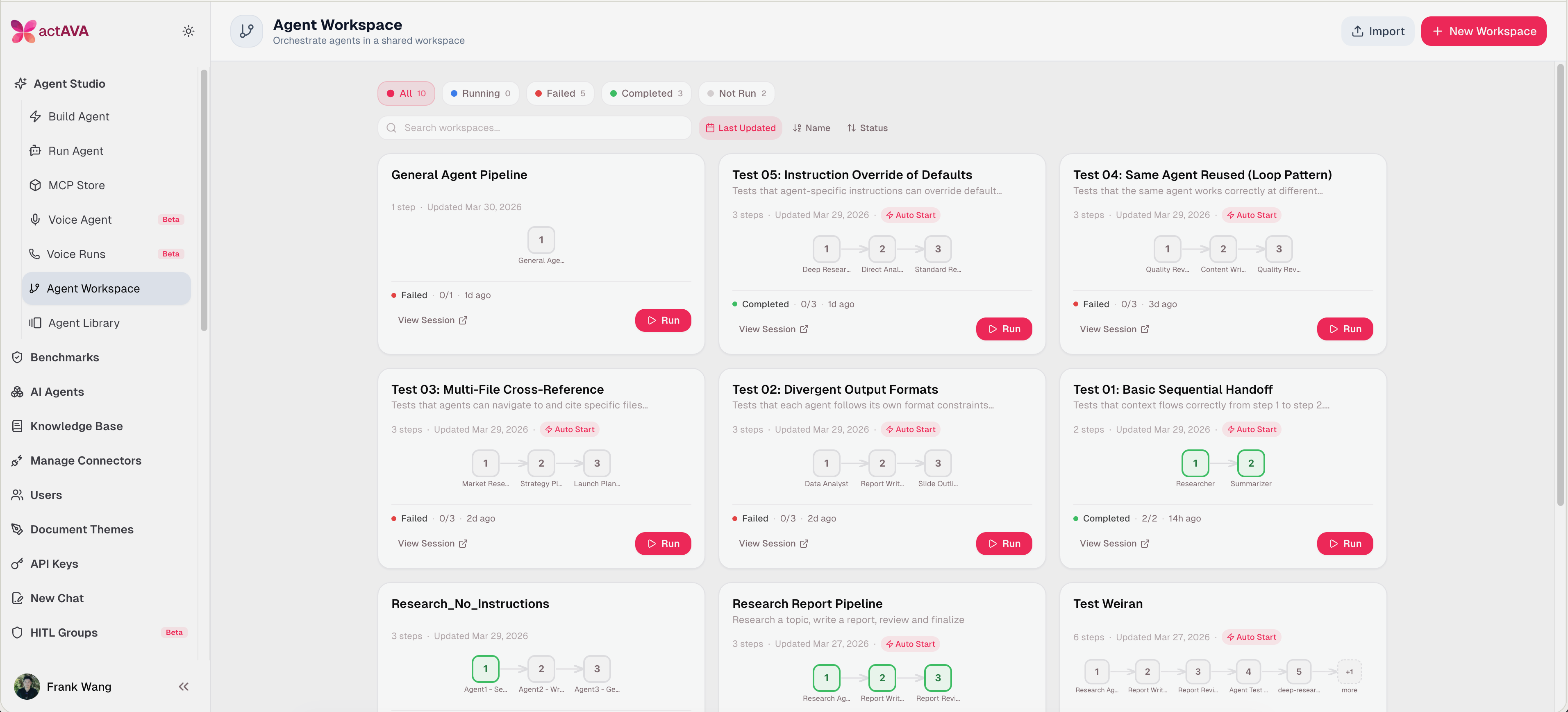
Multi-Agent Pipelines let you compose multiple agents into sequential workflows where each agent contributes to a shared workspace. A clinical research agent gathers evidence, a compliance agent reviews it, and a communications agent drafts the outreach — all orchestrated automatically with full auditability.
Pipeline Builder: Visual step sequencing with agent picker, drag-to-reorder, and per-step configuration. Compact flow visualization provides a clear view of the pipeline topology at a glance.
Server-Side Execution: Pipelines execute on the server with SSE streaming for real-time progress updates. Each step has a 2-hour timeout (a maximum 6-hour pipeline). Run state is continuously synced to the database, surviving container restarts without data loss.
Workspace Dashboard: A right-panel workspace browser shows all files created during pipeline execution, with system files filtered out. A preview drawer displays step results and workspace artifacts as they're produced.
Step Boundary Dividers: Enhanced step transitions in the chat view show status indicators (pending, active, completed, failed), elapsed time, agent names, and collapsible sections. Active steps display with a distinctive blue glow for visual clarity.
Run History & Recovery: Pipeline runs persist to the database with full status tracking. Stale runs are automatically detected and cleaned up. The run history UI supports navigation back to in-progress sessions without blanking the screen. the screen
Redis Streams Event Replay: Agent events are now published to Redis Streams (replacing pub/sub), enabling full event replay from any point. Late-connecting clients receive the complete event history, eliminating missed updates during reconnection.
Microsoft 365 Integration
Full enterprise productivity suite wired directly into your agents.
Microsoft 365 becomes a first-class integration with 62+ tools spanning 7 services. Agents can send emails, schedule meetings, manage files, update spreadsheets, and edit documents — all governed by admin-configurable write permissions that give organizations precise control over what agents can and cannot do.
You can see the 7 new Services, and 62+ Tools below:
Outlook Mail (12 Tools): Send, draft, read, list, search, reply, forward, delete, flag, move, list folders
Calendar (8 Tools): Create/update/delete events, list events, find free time, accept/decline invitations
OneDrive Files (12 Tools): Upload, download, list, search, move, copy, delete, share, create folders, get permissions, recent files
SharePoint (13 Tools): Search sites, list drives/items, create/update/delete list items, upload/download files
Excel Online (6 Tools): Read/update cell ranges, append rows, clear cells, get table metadata, list worksheets
Word Online (7 Tools): Create documents, read/insert/append text, find & replace, get info, delete ranges
Contacts (6 Tools): Create, list, get, update, delete, search contacts
New Enterprise Governance:
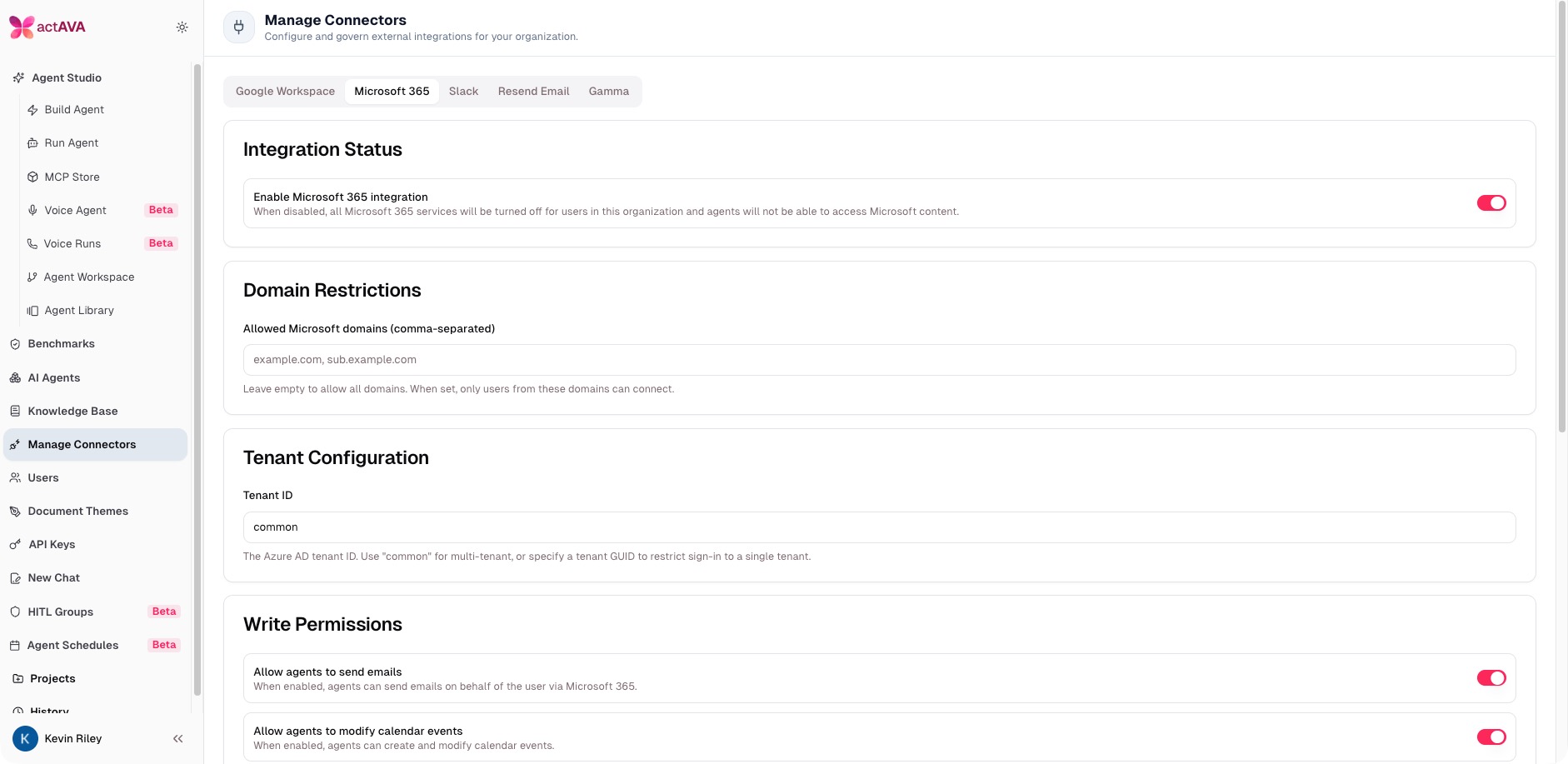
OAuth 2.0 PKCE Flow: Tenant-aware endpoints, automatic token refresh, and encryption at rest.
Incremental Consent: Users only grant scopes for the services they actually use. New services can be added later without re-authorizing everything.
9 Configurable Write Gates: Org admins control exactly which write operations agents can perform — allow_agent_mail_send, allow_agent_calendar_write, allow_agent_files_write, allow_agent_files_share, allow_agent_sharepoint_write, allow_agent_contacts_write, allow_agent_excel_write, allow_agent_word_write, allow_agent_word_delete.
Domain Allowlist: Restrict which Microsoft email domains can connect, preventing unauthorized access to accounts.
Admin Dashboard: Org-level config UI with write permission toggles, tenant ID configuration, user connection management, and connection revocation.
Per-Service Toggles: Enable or Disable individual services after connection for fine-grained control.
7 Graph API clients (Mail, Calendar, Contacts, OneDrive, SharePoint, Excel, Word) with automatic retry, exponential backoff, and timeout configuration
9 backend route services + internal agent execution endpoints
3 database migrations for OAuth state, token storage, and connection tracking
Comprehensive test suite: ~30+ test files across common, backend, integration, and cortex layers
Agent Studio & Runtime Improvements
Pretext Text Measurement
Chat message layout calculations are now powered by the pretext library, replacing expensive ResizeObserver-based measurements with precise, font-aware text-width calculations. The useTextMeasurement hook uses an estimate+correct pattern that eliminates layout shifts during streaming. Sidebar overflow detection uses the same measurement system for consistent, flicker-free rendering.
Background Agent Resilience
Long-running background agents now maintain a heartbeat loop for liveness detection. A stale reaper automatically retries orphaned runs, and a new /scheduled-runs/resume endpoint enables crash recovery from the last checkpoint. Agents that previously could silently die after container restarts now resume reliably.
Remote Execution for Agent Cards
Agents can now be configured for remote execution, dispatching workloads to dedicated compute containers. A Remote Execution toggle is available in both the classic builder view and agent card settings, enabling resource isolation for compute-intensive agent workflows.
Inspect Panel Enhancements
The Inspect panel's waterfall trace view now features a user-resizable label column with drag-to-resize and hover hints. Plan compliance metrics display is enhanced with better formatting. Tool events appear immediately instead of waiting for completion, and a polished petal spinner animation provides visual feedback during loading. The right panel now sizes relative to the chat container for consistent proportions across screen sizes.
Voice Session Inspection
Voice sessions now include detailed trace spans with correct ordering and timing, viewable in the Inspect panel. Workspace and Inspect panels are mutually exclusive for a focused review experience.
Enterprise Integrations
MCP OAuth Integration
Agents can now connect to OAuth-protected third-party services through a streamlined authorization flow. OAuth connect/disconnect is available directly from the MCP Marketplace page. When an agent encounters a tool that requires authentication, an OAuthConnectBanner prompts the user in chat. Tokens are encrypted at rest and automatically refreshed at runtime — users authorize once, agents access tools indefinitely.
Multi-Org Slack Workspace Support
Enterprise customers with multiple actAVA organizations connected to a single Slack workspace now get a clean disambiguation experience. Slash commands display an org picker modal when multiple orgs are detected, HITL notifications resolve the correct org from session records, and bot token fallback ensures reliable message delivery.
Google Drive Knowledge Base Indexing
Google Drive files can now be indexed directly into an agent's knowledge base. Files are parsed using LlamaParse for high-quality document extraction, with optional Contextual Retrieval (Claude enriches chunks with surrounding context before embedding). Supports org, project, agent, and personal scoping with full status tracking (queued, indexing, complete, error) and PHI-safe error sanitization.
actAVA Knowledge MCP Server
The actAVA Knowledge MCP server is now available as a first-party MCP integration, providing agents with direct access to the organization's RAG knowledge base. Routing rules are configured across all environments with proper authentication handling.
Evaluations & Synthesis
Synthesis v2: Batch Checkpoint & Recovery
Data synthesis jobs are now production-grade and reliable. Batch checkpointing saves progress mid-run and resumes from the last checkpoint on failure. Dataset reuse allows re-running synthesis without regenerating the underlying dataset. Analysis results are cached and reused across retries. The deprecated CUES pipeline has been removed in favor of the v2 architecture.
External Synthesis E2E Testing
A new end-to-end test pipeline validates synthesis jobs against live infrastructure and automatically reports results to Slack. External synthesis is available in non-production environments for testing and validation.
Synthesis Proxy Through Backend v2
Synthesis API calls are now proxied through the backend service (v2 architecture), providing cleaner separation of concerns, consistent authentication, and better error handling. The evals service no longer needs direct access to the synthesis infrastructure.
Post-Call LLM Extraction for Voice
Voice sessions now support configurable post-call extraction with an LLM-powered pipeline that generates structured outputs (summary, sentiment, action items, caller info). Extraction settings are configurable in the voice agent builder, with HIPAA mode support and per-field toggles.
Infrastructure & Cost Optimization
3x Daily Automated Deploys
Development deploys now run three times daily (5:30 AM, 12:00 PM, 6:00 PM) via a centralized orchestrator. Build number tracking, SHA capture at workflow start, and skip-if-unchanged logic ensure efficient, traceable deployments across all submodules with Slack-reported summaries.
Redis Streams for Event Durability
Agent event streaming migrated from Redis Pub/Sub to Redis Streams, providing append-only durability with configurable retention (10,000 events per stream). Late-joining subscribers receive a full event replay, eliminating the data-loss window inherent in pub/sub. Task-active sentinels with 10-minute TTL and 60-second grace periods ensure clean lifecycle management.
Backend Test Coverage
341 new unit tests added to backend services, improving coverage from 60% to 65%. Includes repair of 12 pre-existing test failures from stale mocks.

Written by
Deon Metelski
Chief Product Officer